Great Garbage Patch Stuff You Should Know
An Ocean-Sized Trouble
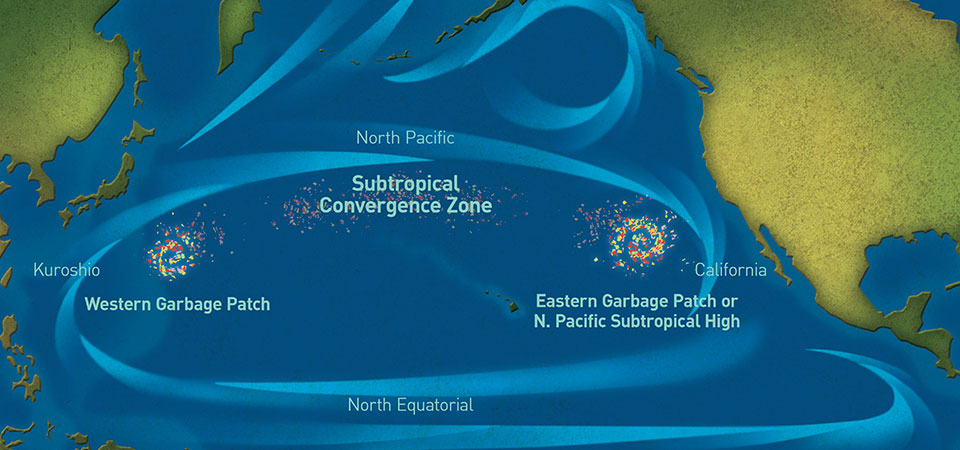
The Great Pacific Garbage Patch is one of many areas in the body of water where marine debris naturally concentrates because of body of water currents. In this episode, Dianna Parker from the NOAA Marine Debris Program explains what a garbage patch is and isn't, what we know and don't know, and what we tin can do virtually this ocean-sized problem.
Heed:
What is the Great Pacific Garbage Patch? What does it look like? Why can't we merely make clean information technology up?
Transcript
This is Making Waves from NOAA'due south National Ocean Service. I'm Troy Kitch. The Great Pacific Garbage Patch. I bet you've heard of information technology. It's a phrase that's really caught on in the past few years. And it's easy to run into why: information technology conjures upwardly a powerful image ... a vast vortex of homo waste — plastic bags, tires, cans, barrels, you lot proper noun it ... floating out there in the bounding main. But here's the thing: information technology doesn't really look like that at all. What it looks similar to the man middle, from satellites, is, for the nigh part, well ... not much at all. About of it is all just invisible. How can that be? Well, I recently sat downwardly with Dianna Parker from the NOAA Marine Debris Program to discover out what the garbage patch is and isn't, what we know and don't know, and what we can do about this bounding main-sized problem. Dianna, welcome and thanks for joining us. Let's start with the obvious question: what are we talking about when nosotros say 'garbage patch?'
[Dianna Parker] "A lot of people hear the word patch and they immediately recall of nigh like a blanket of trash that can hands be scooped up, merely actually these areas are always moving and irresolute with the currents, and information technology'south generally these tiny plastics that you can't immediately encounter with the naked eye."
I noticed that y'all said garbage patch 'areas.' So the Great Pacific Garbage Patch is only i area in the body of water where marine debris concentrates?
[Dianna Parker] "In that location are garbage patches all over the earth. These are areas where droppings naturally accumulates. So at that place are garbage patches of all dissimilar sizes and shapes and compositions. The one that we know the most about is the Swell Pacific Garbage Patch which lies in an area between Hawaii and California. What we know about this expanse is that information technology's made upwardly of tiny micro plastics, near akin to a peppery soup, with scattered larger items, fishing gear, those kind of items swirling around."
A fiery soup? Could you explain that again?
[Dianna Parker] "Well, imagine tiny, tiny micro plastics just swirling effectually, mixing in the water column from waves and wind, that's always moving and changing with the currents. These are tiny plastics that you might not even see if you sailed through the middle of the garbage patch, they're so minor and mixed throughout the water column."
I would call up that almost of the plastics that ends up in the ocean are bigger pieces ... similar bags and bottles and plastic toys. But you're saying that most of the plastic is and so small that's it's difficult or incommunicable to meet. Tin can you talk a fiddling more about the plastic droppings in the bounding main ... why information technology'southward so modest?
[Dianna Parker] "In that location are many unlike kinds of plastics out in the ocean and they come from a number of different sources. So, there are teeny, tiny micro plastics out at that place that were either manufactured to be small — for case, the microbeads in confront wash can be plastic; there are also piddling, tiny plastic pellets that nosotros sometimes call ''nurdles' that are used to make larger items only then at that place are also tiny plastics that are shards of larger items. Plastics never really get abroad. They just interruption downward over and over and over over again until they become smaller and smaller from sunlight and other environmental factors [like] waves, big storms, those kind of things."
Then we have these vast regions in the body of water where the water column looks similar a peppery soup because of all these small bits and pieces of plastic. I would imagine this plastic kind of looks like nutrient. Do nosotros know if fish and birds are eating this stuff?
[Dianna Parker] "Nosotros know that some species of birds and fish consume micro plastics. They even consume some larger plastics. So for example, the Laysan Albatross in the Northwestern Hawaiian Islands, nosotros know that merely well-nigh every dead boundness found on Midway Atoll has some form of plastic in its stomach. We don't know if that's what killed it, only we know that this is becoming a big trouble. So we know that at that place are micro plastics in the ocean. We know that birds and fish and even some larger marine mammals consume these plastics. We know in that location are chemicals in the plastics and we know that the chemicals tin blot other toxic chemicals that are floating around in the ocean. And then now the large question is, what are those plastics doing to the animals that swallow them."
I'm sure you go this question a lot: we know marine droppings in the ocean is a bad thing ... then why don't nosotros but clean it up? Especially if near of the trash is independent in 'garbage patch' areas because of the way the debris naturally accumulates because of bounding main currents.
[Dianna Parker] "The words 'garbage patch' accurately describes what it is, because these are patches of ocean that contain our garbage. But they're non areas where you can hands go through and skim trash off the surface. First of all, because they are tiny micro plastics that aren't easily removable from the sea. But also just because of the size of this area. We did some quick calculations that if you tried to clean upward less than one percent of the North Pacific Ocean information technology would have 67 ships one year to clean upwardly that portion. And the lesser line is that until we preclude droppings from entering the ocean at the source, it's merely going to keep congregating in these areas. We could get out and clean information technology all up and then still have the aforementioned problem on our hands equally long as there's droppings entering the sea."
And that'due south actually the big problem — to foreclose the droppings from entering the ocean in the offset place. So what can y'all, me, or anyone do to assist?
[Dianna Parker] "At that place's so much that we tin practise to go along debris from inbound the bounding main. It's every bit unproblematic as irresolute your private beliefs every day, creating less waste, reusing what you can, remembering to recycle ... littering is apparently a no-no. And and so going out and joining a beach clean up. It'due south hard to really understand the trouble until you lot get out there and meet it kickoff-manus, how bad the problem is."
And I imagine you've had plenty of opportunities to go out there and meet how bad information technology is first-hand.
[Dianna Parker] "I absolutely have. For example, every year I become out with the International Coastal Cleanup and work to selection upwards trash from the Anacostia and Potomac in Washington, DC, and the amount of trash y'all find on the shorelines is merely incredible. Bottles, bags, aerosol cans, all mixed together. In some places it'southward like a thick mat. And so these are really populous, urban areas. But then we also see the same kind of trash on really remote beaches. For example, I was on beach in Lanai in Hawaii and we constitute everything from plastic bottles to flip flops, fishing gear, we found an entire couch. And some of this debris was conspicuously local and some of it had clearly come from other countries around the Pacific Rim. So debris tin affect even the well-nigh remote places."
Given what y'all know, working on this problem twenty-four hour period in and day out, I would think it would feel kind of like a hopeless, overwhelming problem.
[Dianna Parker] "It'south not a hopeless situation. Marine debris is absolutely a solvable problem because it comes from us humans and our everyday practices. We can have whatever number of steps to keep information technology from entering the body of water and that tin can happen at the highest level with governments and information technology can happen at the everyman level individuals and everyday choices."
Thanks, Dianna, for taking the time to chat with the states about this. That was Dianna Parker, communications specialist with NOAA'southward Marine Droppings Program. Desire to acquire more? Check our evidence notes for the links. You tin can find us on the spider web at oceanservice.noaa.gov. Accept a question? Shoot usa an e-mail at nos.info@noaa.gov. And thanks for listening to Making Waves from NOAA's National Ocean Service.
armsteadliffiller1983.blogspot.com
Source: https://oceanservice.noaa.gov/podcast/june14/mw126-garbagepatch.html#:~:text=The%20one%20that%20we%20know,kind%20of%20items%20swirling%20around.%22
0 Response to "Great Garbage Patch Stuff You Should Know"
Post a Comment