Lois Mailou Jones Art Lois Mailou Jones the Ascent of Ethiopia 1932

Lois Mailou Jones was born in Boston, Massachusetts on Nov threerd 1905. Her female parent Carolyn ran a beauty parlour and made and designed hats. Her father, Thomas Vreeland Jones was a superintendent of a big role building, who attended dark schoolhouse to become a lawyer. At the historic period of xl he graduated from Suffolk Law School, the kickoff African-American to earn such a degree from that school. He went on to become a lawyer. Whilst still a child her parents moved to a business firm on Martha's Vineyard and it was here that Lois first came into contact with people who were to influence her time to come life.
As a child, Lois enjoyed cartoon and painting and her parents encouraged her. She was given her outset set of watercolours at the age of seven. She enjoyed her fourth dimension at school and recalled:
"…The schools were non segregated and I had the good fortune to have my teachers interested in my talent and I received much encouragement," she said. "My happiness was to go to Martha's Vineyard as soon every bit school was out. Information technology was a great joy to live with nature. Environment is so of import to whatever artist…"
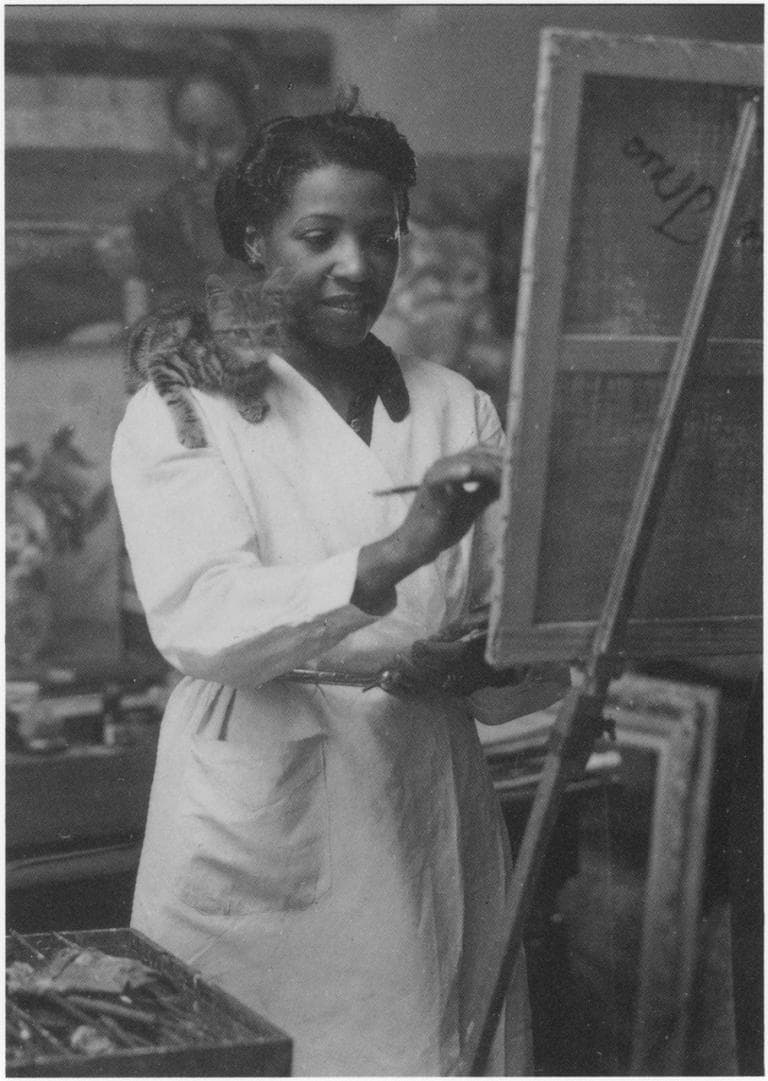
She attended the local primary school and in 1919 she was enrolled at the High Schoolhouse of Applied Arts in Boston. During her iv years of studies there, she also attended evening classes at the Boston Museum of Fine Arts thanks to an almanac scholarship she was awarded. She developed an interest in mode and costume design and became an apprentice with Grace Ripley, an academic and costume designer. Lois Jones worked with Ripley afterwards school and on Saturdays, where she would become familiar with exotic costumes and African masks which would later on feature in her artwork. Her involvement in African masks also led her to creating costume designs for the Denishawn Schoolhouse of Dancing and Related Arts, the first dance academy in the United States to produce a professional dance company.
Lois was only seventeen years former when she held her beginning solo exhibition in Martha's Vineyard. Jones began experimenting with African mask influences during her time at the Ripley Studio. In 1923, at the age of eighteen, Lois attended the School of the Museum of Fine Arts in Boston where she studied, non art, but design. She was an outstanding student and she won the Susan Minot Lane Scholarship in Design. Whilst studying for her degree she also took evening classes at the Boston Normal Art School, a public higher of visual and applied art in Boston.
Lois Jones began to search for something which would bring her recognition as an artist. Whilst searching she discovered the Harmon Foundation of New York, which had been established in 1921 past wealthy existent-manor developer and philanthropist William East. Harmon. Information technology was the first major foundation supporting African American creativity and ingenuity and held national competitions for blackness artists. Lois exhibited several of her works at these exhibitions and received several awards. It was through this foundation that she became interested in black America's 20th century movement known equally the Harlem Renaissance. During the summers of the 1920'due south and 1930's, Lois Jones spent much of her time in Harlem and this had the almost cogitating influence on her early on development as an creative person. During these visits, Jones was engrossed in the art and theories of the Harlem Renaissance. The Harlem Renaissance was an intellectual and cultural revival of African American music, dance, art, mode, literature, theatre, politics. At the time, it was known every bit the "New Negro Motion".
Throughout the early on office of her life she continued to have the opportunity to study. In 1934, she attended classes at Columbia University where she studied different cultural masks and in 1945, she received a BA in art didactics from Howard University, a private, research university, graduating magna cum laude. Not long subsequently Lois left college, she decided to take up the office as an educator. She applied for a teaching mail at the Boston Museum Schoolhouse just the director rebuffed her application maxim that she should use for a job in the South where "her people" lived. This racially prejudiced stance from a person of such stature must accept shocked her. Non to be put off past such bigotry she continued to look for work and finally was accepted for a teaching mail service at Palmer Memorial Institute, a historically black prep school, in Sedalia, North Carolina. The Institute was founded by xix-year-old Charlotte Hawkins Dark-brown, an African American educator in 1902 with the aim of teaching elementary and loftier school students in rural North Carolina. It was named after Brown'south benefactor and friend, Alice Freedman Palmer, and originally the Institute began in an old blacksmith shed. Whilst working as a prep schoolteacher, she taught the children folk dancing, pianoforte playing and even coached a basketball team.
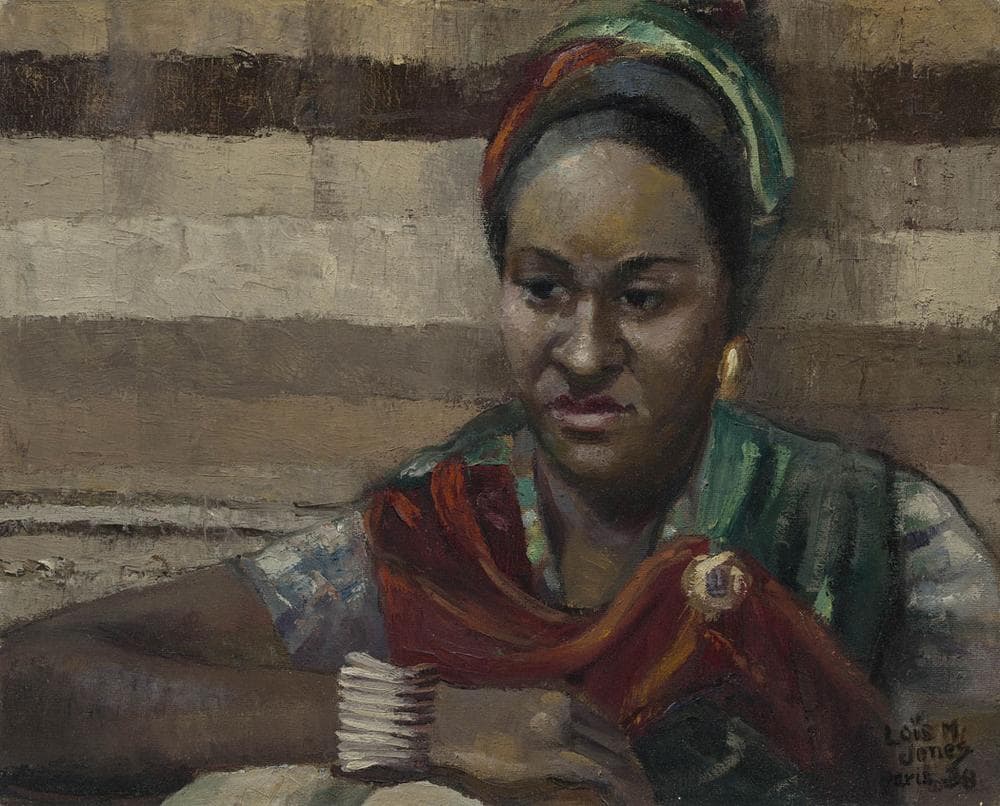
In 1930, Lois was offered and accustomed a position at Howard University in Washington, D.C. by James Herring, who had founded the Art Department at Howard University and served equally mentor to many artists and art historians. Lois Jones remained there, equally professor of design and watercolour painting, until her retirement in 1977. Lois' chief appetite whilst at Howard University was to ensure her students were made ready for a competitive career in the arts and to assistance this ambition she would arrange for established artists and designers to visit her classes and give talks, demonstrations and workshops. In doing this she became an ardent advocate for African-American fine art and artists.

In 1932 Lois Mailou Jones created a painting entitled The Rise of Ethiopia. The painting is the pictorial story of the grim and challenging journey of African Americans who, through years of cede and intolerable difficulties, have managed to create a legacy congenital on their trials and tribulations. It has been a constant fight for African Americans from the time they lived in Africa, the sea voyage to America and once there, how they have had to fight to attain their artistic and intellectual pinnacle. Lois Jones painting depicts this story by her use of certain elements of design and colour, and space. The works she created throughout her life tell the story of many unlike cultures. In this painting she chooses to represent her own culture. This piece of work of art was Jones' way of expressing intense and reflective respect for her race. When we report the painting the first thing our eyes focus on is the effigy wearing a blueish and blackness headdress in the right foreground. It takes up a quarter of the canvas. The figure looks to the left as information technology observes the other figures, who are conveying pots on their heads, and pointing skywards at a bright star. They are all ascending towards a urban center, comprised of 2 large buildings, at the top right of the painting.

In forepart of the buildings are ii entertainers, one of whom is playing the piano whilst the other I think is preparing to sing as we see musical notes all around him. Backside these two big buildings at that place'due south a big circular yellow circular object protruding from the side, surrounded past two blue/turquoise concentric circles. It has a face, and someone on a bended genu appearing to be acting on pinnacle of information technology. The turquoise-coloured circle is bigger than the previous ane and has a face coming out towards the within. Farther up at that place's someone painting on top of the blueish circle with the words art higher up enclosed within the blue circle. A symbolic palette and brush are painted within that aforementioned blue circle, the star in the top left corner has rays of squiggly blue, light-green, and blackness streaks that radiate diagonally. The star is inside of a yellow circle shining downwards on the people gesturing towards it, this film reflects what Jones was trying to convey to her audience. The painting is a tale of transition, a long and tortuous voyage from the poverty of Ethiopia to America where African Americans, through hard work and dogged conclusion, became talented actors, artists and entertainers. It is also about cultural identity.
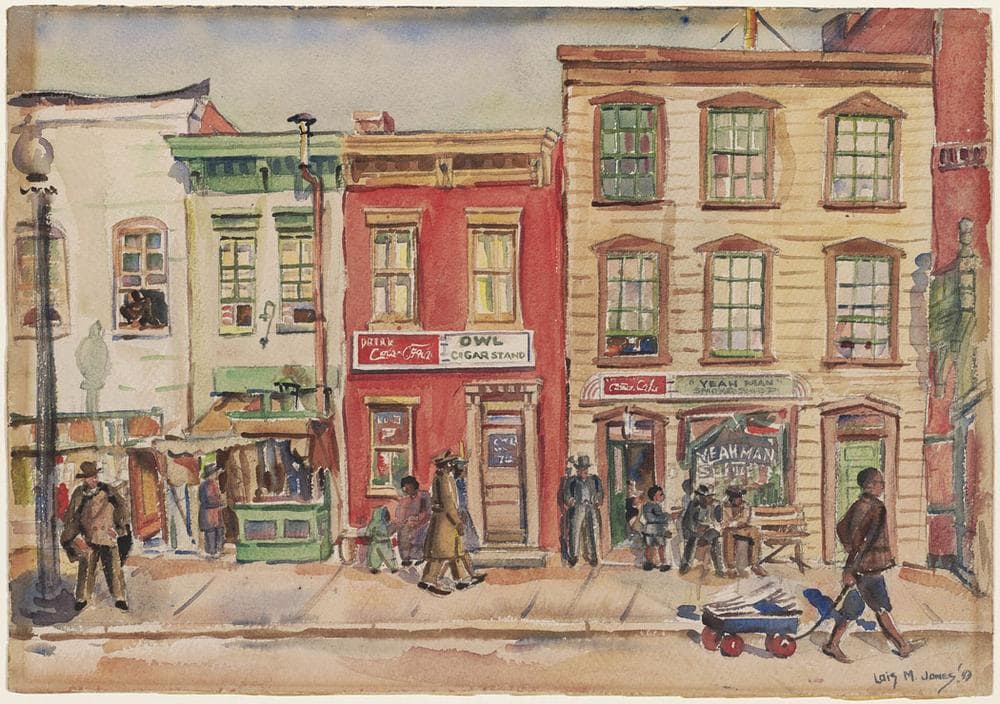
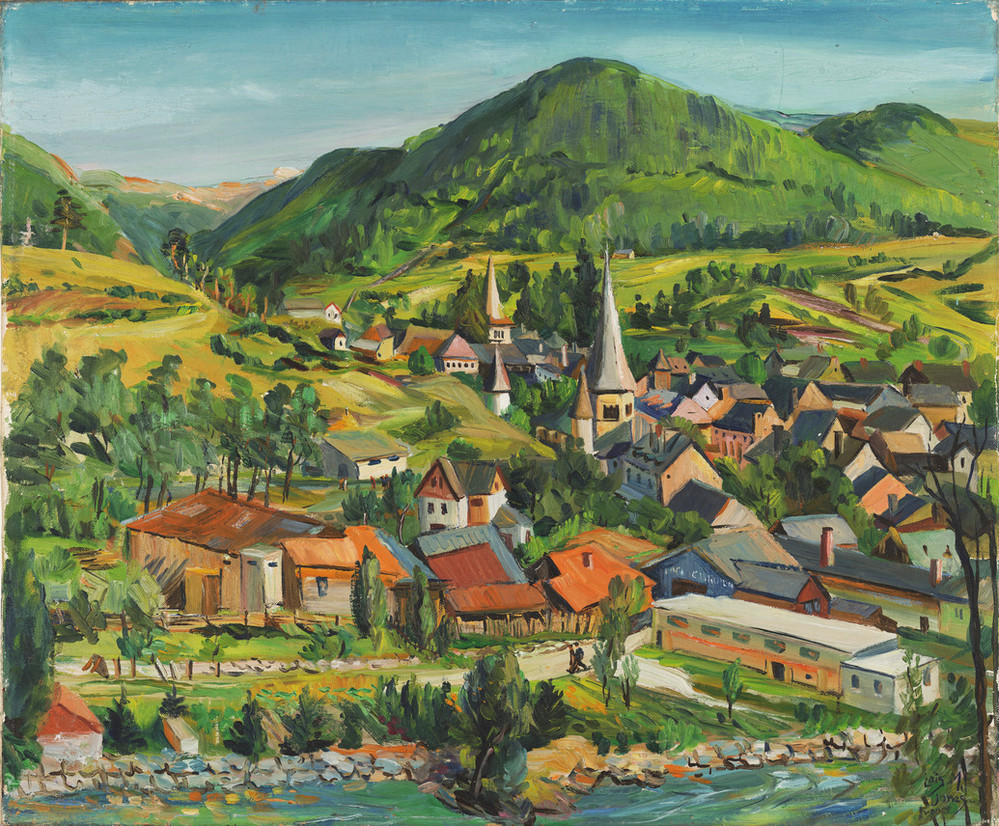
In 1937, Jones was awarded a fellowship to travel and report in Paris at the Académie Julian. That year, whilst in France, she produced more than forty works of art, including xxx watercolours, may of which were plein air renditions. 2 of her paintings were accepted at the annual Salon de Printemps exhibition at the Société des Artists Français for her Parisian debut. What also pleased Lois during her twelve months stay was that different in America, she was fully accepted in society and that the colour of her skin mattered fiddling. She managed to obtain an extension to her fellowship which allowed her to travel to Italy.

In 1938, she completed one of her best-known pieces, entitled Les Fétiches. It was and African inspired painting that now hangs in the Smithsonian American Art Museum. Painted in a Modernist style information technology features v overlapping masks from different African tribes and conveys a mysterious spiritual dimension summoned by ritual trip the light fantastic toe. To the right of the main mask, nosotros see what is known as a red religious' fetish. The term "fetish" (fétiche in French) refers to an object believed to accept supernatural powers, or in particular, a human-made object that has ability over others. The masks and fetish appear to float in the mass of a blackness painted sail. When in France, Lois would probably accept seen many different African objects and masks at the Musée de l'Homme, an anthropology museum in Paris. In Les Fétiches, the Songye people's masks and African Dan masks are visible.
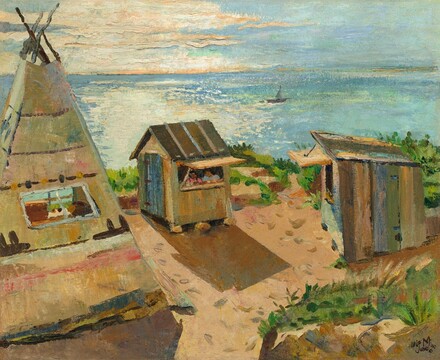
In 1941, Lois Jones entered her painting Indian Shops Gay Head, Massachusetts, into the Corcoran Gallery's annual contest which she had completed the previous year. For her the main problem with exhibiting her work at this prestigious exhibition was that the Corcoran Gallery prohibited African-American artists from entering their artworks themselves and only work from "white" artists was deemed acceptable. Jones asked Céline Marie Tabary, her friend and arts professor at Howard Academy who championed African-American art in 1940s Washington, D.C. to enter her painting so as to side-step the racist rule. This painting past Lois won the Robert Forest Elation Laurels but she could not collect the honor herself and she had to adjust for Tabary to mail the award to her. In 1994, the Corcoran Gallery of Art gave a public amends to Jones at the opening of the exhibition The Globe of Lois Mailou Jones, 50 years after Jones hid her identity.

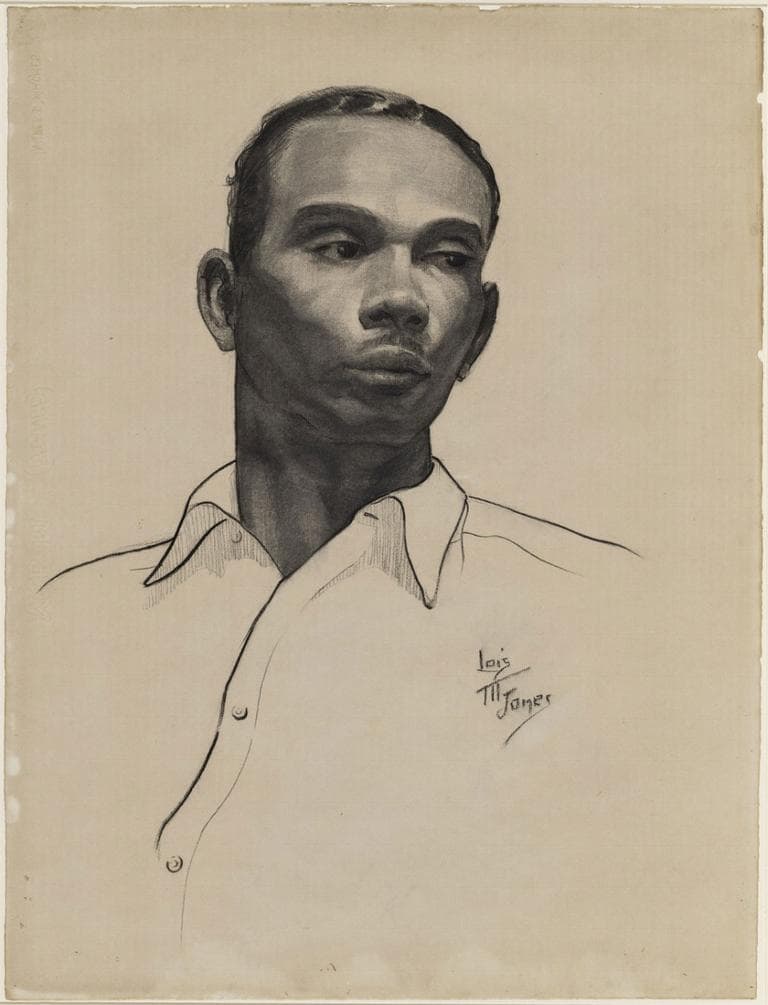
In 1944 Lois Jones painted one of her almost controversial and thought-provoking works. A philosophy professor at Howard Academy and founder of the Harlem Renaissance, Alain Locke, encouraged her to describe her heritage in her paintings and this led to her painting, Mob Victim (Meditation). She remembered how the painting came into being, saying that she had been walking along U Street Northwest in Washington, DC. when she saw a human walking along and she stopped him and asked if he would pose in her studio for her painting which would describe a lynching scene. The human told Lois that he had actually witnessed a lynching and mimicked the pose that the man held before being lynched and visually illustrated a contemplation of imminent decease which was well understood by blacks during the 1940s. The epitome nosotros see of the human whips up deep and powerful feelings equally we observe the innocence of the blackness man who is calling into question the intolerable actions of society. Expect at the questioning expression in the man's eyes. It is a very emotional work which poses the elementary question, why?
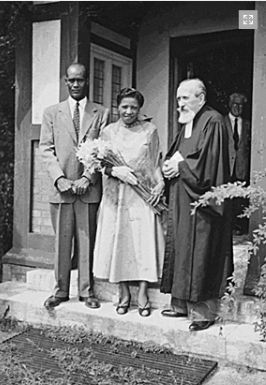
In 1953, at the age of forty 7, Lois finally married Haitian graphic artist Louis Vergniaud Pierre-Noel.. They had been close friends for xx years and he had influenced Lois by introducing her to the bright colours and bold patterns of Haitian fine art and she would immerse herself in the Haitian civilisation during their annual trips to her hubby'south homeland. Jones's manner shifted once more after she married She one time said that the art of Africa is lived in the daily life of the people of Republic of haiti.

In 1970 she visited Africa for the first fourth dimension. She journeyed to eleven unlike countries on the African continent. The trip had been made possible with a grant from Howard University to go on a record of the various artists she met. She returned to the African continent in 1972, 1976 and 1977. In the painting a young woman looks out at united states of america from under her partially closed eyelids. The girl's face is surrounded by two types of masks: in contour, is a large Dan mask from Liberia or Côte d'Ivoire, and drawn within orangish outlines are two Pende masks from the Democratic Republic of the Congo. Masks were thought to exist powerful ways of communicating with spirits; the Dan mask represents a specifically female spirit, and the blue and ruby twisting lines in the lower left corner are a design of the Edo, from Benin Kingdom, chosen "rope of the world" representing a person's lifetime., The woman's brow and cheeks are painted white for her initiation celebration into womanhood and vivid diagonal cherry lines overlap at the bridge of her nose, which leaves her oral fissure and chin uncovered. Loïs Mailou Jones was absorbed by this woman and created the portrait in 1972, entitled Ubi Girl from Tai region. The Tai region was part of Côte d'Ivoire, which Lois visited during her extended trip to Africa. The artist had a long-held dream of traveling to Africa since her twenties, and at the age of 65, she fulfilled her career-long appetite.

Jones continued to produce beautiful works of art. On her 84th altogether in November 1989, Jones had a major centre attack which necessitated a triple bypass functioning. On June 9th 1998, Jones died at the age of 92 at her domicile in Washington, DC and is cached on Martha's Vineyard in the Oak Bluffs Cemetery.

0 Response to "Lois Mailou Jones Art Lois Mailou Jones the Ascent of Ethiopia 1932"
Post a Comment